Why Ceramic Luminous Christmas Trees Are a Strong Wholesale Category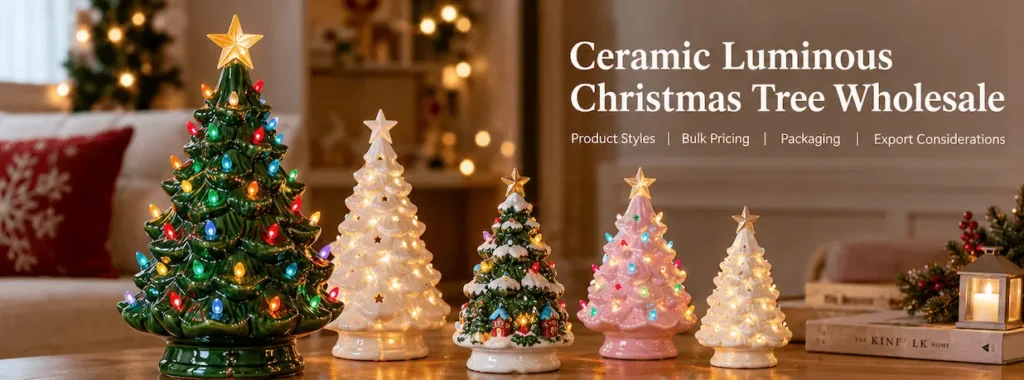
Ceramic luminous Christmas trees combine traditional holiday charm with decorative lighting, making them attractive products for seasonal home décor, gift collections, and festive retail displays. Their glazed surfaces, colourful details, and warm illumination create a nostalgic atmosphere while offering retailers a distinctive alternative to conventional Christmas decorations.
For importers, wholesalers, gift shops, e-commerce sellers, and private-label home décor brands, ceramic luminous Christmas tree wholesale offers opportunities to develop seasonal collections across different price points. Classic green trees appeal to traditional shoppers, while minimalist white and contemporary pastel designs suit modern interiors.
However, successful sourcing involves more than selecting an attractive design. Buyers must evaluate ceramic quality, lighting components, bulk pricing, protective packaging, production lead times, and export requirements.
As a sourcing partner for custom ceramic products, Homey Ceramic supports B2B buyers looking for decorative ceramics, OEM/ODM development, and coordinated product sourcing. This guide explains how to evaluate a ceramic luminous Christmas tree supplier, compare quotations, and prepare a reliable bulk order.
1. Understanding Ceramic Luminous Christmas Trees
A ceramic luminous Christmas tree is a tabletop Christmas decoration made from ceramic or porcelain and designed to illuminate through integrated or internal lighting. Typical features include glazed finishes, decorative openings, a tree topper, and an LED lighting module.
The terms luminous, lighted, LED, and pre-lit are often used interchangeably in product listings. Nevertheless, buyers should confirm the actual lighting configuration rather than relying on the product name.
Important components include:
- Ceramic body: The shape, wall thickness, glaze quality, and firing consistency affect appearance and durability.
- Light openings: Star-shaped or round openings allow illumination to shine through the ceramic body.
- Lighting system: LEDs may produce warm white, cool white, multicolour, or colour-changing effects.
- Power supply: Options may include batteries, USB connections, DC adapters, or plug-in systems.
- Switch and base: Switch placement, stability, and anti-slip features influence everyday usability.
- Retail packaging: Protective inserts and attractive presentation help prepare products for retail sale.
When sourcing a wholesale ceramic luminous Christmas tree, request clear specifications for each component. If lighting is integrated, clarify who supplies the electronic parts, who assembles them, and what functional testing is performed before shipment.
2. Popular Ceramic Luminous Christmas Tree Styles for Wholesale Buyers
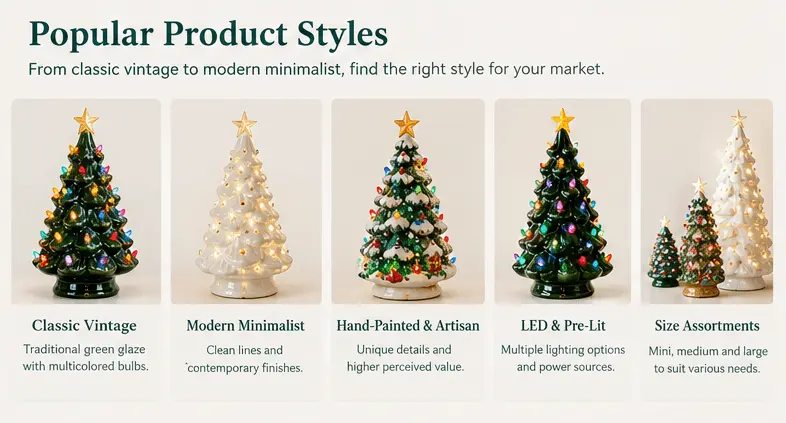
Classic Vintage Ceramic Trees
Traditional green ceramic Christmas trees with multicoloured bulb openings remain a recognisable holiday style. Their nostalgic appearance suits gift shops, traditional home décor retailers, and seasonal collections.
A ceramic Christmas tree manufacturer may offer different heights, decorative bulb colours, base shapes, and tree toppers. Buyers should check the consistency of the green glaze and the fit of any removable decorative accessories.
Modern Minimalist Ceramic Trees
White, ivory, matte, and pastel ceramic trees appeal to contemporary home décor brands. Their simple silhouettes and restrained colour palettes work well in Scandinavian interiors, modern farmhouse collections, and premium seasonal displays.
These styles can also be coordinated with ceramic candle holders, miniature houses, vases, and other festive accessories to create a cohesive retail collection.
Hand-Painted and Artisan-Style Trees
Hand-painted snow effects, floral motifs, metallic accents, and detailed festive scenes can increase perceived value. These products are suitable for specialist gift retailers and brands seeking a more distinctive seasonal assortment.
For bulk ceramic luminous Christmas trees with hand-painted details, buyers should establish acceptable colour variation and finishing tolerances before production. A signed-off sample provides a practical reference for evaluating the finished goods.
LED and Pre-Lit Designs
LED lighting can create a warm, welcoming atmosphere while highlighting the ceramic surface and decorative openings. Battery-operated models offer flexibility in retail displays, while USB-powered or adapter-powered versions may suit locations with convenient access to electricity.
Before approving a design, confirm LED brightness, colour temperature, lighting modes, switch operation, power requirements, and access to replaceable batteries where applicable.
Size-Based Product Assortments
A balanced assortment can include three broad categories:
- Mini trees: Suitable for gift sets, impulse purchases, and smaller displays.
- Medium tabletop trees: Versatile options for mainstream home décor and gift retailers.
- Large statement trees: Suitable for premium collections and prominent seasonal displays.
Combining different sizes allows buyers to serve multiple customer budgets without relying on a single product configuration.
3. How to Choose the Right Product Mix
Before placing a ceramic luminous Christmas tree wholesale order, define the target customer and intended retail price.
Mass-market retailers may prioritise competitive pricing, consistent quality, and efficient packaging. Gift shops may prefer distinctive finishes and attractive presentation, while e-commerce sellers need compact cartons and reliable transit protection. Private-label brands may place greater emphasis on exclusive colours, branding, and coordinated collections.
A practical assortment can combine classic green, white, and pastel designs with entry-level, mid-range, and premium options. Where demand supports it, buyers can also offer different lighting configurations or coordinated product sets.
Prepare a specification sheet covering:
- Material: ceramic or porcelain.
- Product dimensions and weight.
- Glaze colour, finish, and decoration method.
- LED type, quantity, brightness, and colour.
- Power source, battery requirements, and switch location.
- Accessories and assembly requirements.
- MOQ per design and colour.
- Sample and bulk production lead times.
- Individual packaging and master-carton specifications.
Providing these details helps a ceramic luminous Christmas tree supplier prepare a more accurate quotation and reduces misunderstandings during production.
4. Ceramic Luminous Christmas Tree Bulk Pricing
Understanding the Wholesale Price Structure
The unit price of ceramic Christmas decorations generally depends on order quantity, product complexity, material usage, decoration, lighting components, and packaging requirements. Larger orders may reduce the unit cost, although the actual savings depend on production arrangements and the product specification.
When requesting ceramic luminous Christmas tree bulk pricing, ask for quotations at several quantities, such as a trial order, a standard wholesale order, and a larger-volume order.
Confirm whether the quotation includes sampling, mould development, LED components, assembly, retail packaging, and export cartons. Custom colours, logos, printing, and bespoke moulds may involve additional costs.
Key Factors Affecting Price
Product size and weight: Larger or heavier ceramic trees generally require more material and may increase packaging and freight costs.
Decoration method: Plain glazed finishes may be more economical than detailed hand painting, multiple-colour decoration, or specialised surface effects.
Lighting components: LED modules, battery compartments, switches, wiring, and power accessories affect the final cost.
Customisation: Exclusive shapes, bespoke colours, logos, and custom packaging may require development work or additional setup fees.
Order quantity and timing: Production volume and seasonal capacity can influence pricing and delivery schedules.
Packaging: Retail-ready colour boxes and customised gift packaging usually cost more than standard protective packaging.
Calculate the Total Landed Cost
Comparing factory prices alone can lead to misleading purchasing decisions. Buyers should calculate the full landed cost:
Total landed cost = Product cost + Packaging + Freight + Insurance + Import duties + Inland delivery
FOB generally means the seller delivers the goods on board the nominated vessel at the agreed port, with responsibilities allocated under the applicable Incoterms. CIF includes cost, insurance, and freight to the named destination port, while DDP places substantially more delivery and import-clearance responsibility on the seller, subject to the agreed terms.
Request comparable quotations using the same product specifications, order quantity, packaging requirements, and delivery terms.
Practical Negotiation Tips
When negotiating with a ceramic luminous Christmas tree supplier, ask about tiered pricing, mixed-design quantities, repeat-order pricing, and whether different colours can share a production arrangement.
Also confirm the deposit, balance-payment timing, quotation validity, sampling charges, and any tooling fees. Written confirmation of these details makes budgeting and supplier comparison easier.
5. Packaging Requirements for Fragile Ceramic Christmas Trees
Packaging is especially important for ceramic luminous Christmas tree wholesale orders because ceramic bodies can break during handling and international transport.
Retail Packaging
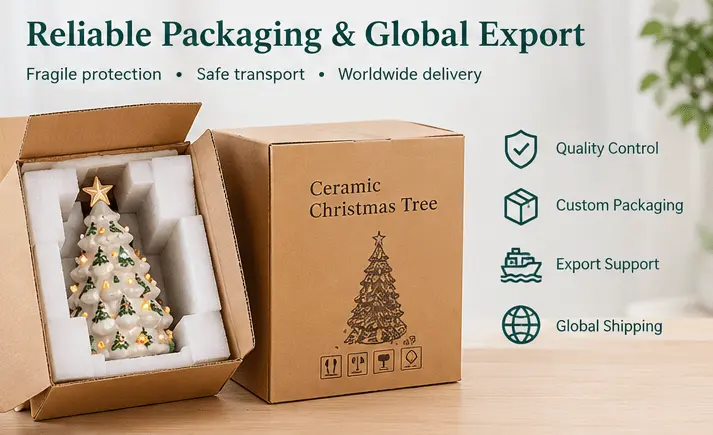
Retail packaging may include a branded colour box, barcode, product information, multilingual labels, and instructions for operating the lighting system.
Gift boxes or premium rigid boxes can improve presentation for higher-end products. For online retailers, clear product photography showing the illuminated effect is also useful for product listings and marketing materials.
Protective Export Packaging
Each ceramic tree should have appropriate individual protection. Depending on the shape and fragility, options may include foam inserts, moulded pulp, bubble wrap, corrugated dividers, or custom-fit protective supports.
Buyers should confirm:
- Individual box dimensions and materials.
- Master-carton quantity, dimensions, and gross weight.
- Protection for fragile tree toppers and protruding details.
- Whether lighting components are pre-assembled or packed separately.
- Carton strength, stacking guidance, and shipping marks.
Where batteries or electronic accessories are included, packaging and labelling should reflect the actual product configuration and destination-market requirements.
Reducing Transit Damage
Before approving a bulk ceramic luminous Christmas tree shipment, consider drop testing or other suitable transit testing. Check that the packaging prevents movement and protects vulnerable areas.
Agree in advance on inspection procedures, defect reporting, and the process for handling damaged or defective products. Strong packaging can help reduce claims, replacement costs, and disruption to seasonal sales.
6. Quality Control and Product Safety
Approve a Pre-Production Sample
A physical sample is an important reference for mass production. Buyers should approve the ceramic shape, dimensions, glaze colour, decorative details, LED brightness, switch operation, stability, and packaging before production begins.
Record the approved specifications in the purchase order or product specification sheet. For customised products, keep a reference sample or documented approval record.
Inspect Production and Finished Goods
For large or customised orders, consider in-process inspections and pre-shipment inspection.
A suitable inspection should cover:
- Ceramic cracks, chips, glaze defects, and uneven finishes.
- Consistency of shape, colour, and decorative details.
- LED operation and switch functionality.
- Stability and assembly quality.
- Battery-compartment fit and accessory completeness.
- Packaging condition, carton markings, and order quantity.
A ceramic luminous Christmas tree supplier should be able to explain its inspection process and discuss arrangements for independent third-party inspection where required.
Check Applicable Safety Requirements
Requirements depend on the destination market, intended use, and actual product construction.
For ceramic components, buyers may need to assess applicable chemical restrictions or glaze-related requirements. For electrical or battery-powered products, relevant obligations may involve electrical safety, electromagnetic compatibility, restricted substances, batteries, labelling, and transport documentation.
Depending on the product and market, standards or regulatory frameworks such as CE-related requirements, RoHS, REACH, UKCA, FCC, UL, or ETL may be relevant. These are not interchangeable certifications, and not every product requires every mark.
Ask for valid test reports and documentation applicable to the specific model. Confirm the responsible party for compliance testing before placing the order, rather than assuming that all certificates are automatically included.
7. Export and Logistics Considerations
Evaluate Supplier Export Capability
A reliable ceramic luminous Christmas tree supplier should provide clear information about sourcing arrangements, quality control, packaging, production capacity, and shipping coordination.
Buyers should check the supplier’s experience with fragile ceramic décor and its ability to manage seasonal production schedules. If the supplier coordinates production through multiple manufacturing partners, ask how specifications and inspection standards are maintained across the supply chain.
Homey Ceramic works with vetted manufacturing partners to support B2B buyers sourcing ceramic home décor and customised products. This approach can help buyers coordinate product development, manufacturing requirements, and export arrangements through one business contact.
Understand Shipping Terms and Documents
Common shipping terms include EXW, FOB, CIF, and DDP. The correct choice depends on the buyer’s logistics arrangements, destination, and preferred allocation of costs and responsibilities.
Typical export documents may include a commercial invoice, packing list, bill of lading or airway bill, and certificate of origin where required. Additional declarations, test reports, or battery-related transport documents may be necessary depending on the product and destination.
Confirm who will arrange customs clearance, pay import duties, and manage final delivery before production is completed.
Plan for Christmas Lead Times
Seasonal orders require backward planning from the intended retail launch date. Allow time for product development, mould making where necessary, sample approval, ceramic production, glazing, painting, LED assembly, inspection, packaging, and shipping.
Ocean freight can take substantial time, and peak-season congestion may introduce additional uncertainty. Buyers should discuss realistic production and shipping schedules with their supplier before confirming a launch date.
For ceramic luminous Christmas tree wholesale projects, early planning helps reduce the risk of late arrivals and missed seasonal sales opportunities.
8. Private Label and Custom Ceramic Luminous Christmas Trees
Private-label development allows retailers and brands to create products that reflect their own visual identity rather than competing solely on standard designs.
Possible customisation options include:
- Exclusive tree shapes, heights, and silhouettes.
- Custom glaze colours and decorative finishes.
- Hand-painted details, decals, and logos.
- Different lighting colours and power configurations.
- Custom tree toppers or decorative accessories.
- Branded colour boxes, inserts, barcodes, and labels.
Customisation is particularly useful for brands developing coordinated Christmas collections, corporate gift programmes, or differentiated seasonal products. However, new moulds, sampling, and specialised components may increase development costs and minimum order requirements.
Homey Ceramic supports buyers seeking customised ceramic products through its custom ceramics service. Buyers can discuss design references, product dimensions, surface finishes, branding, and packaging requirements to assess feasibility.
As a sourcing partner, Homey Ceramic can coordinate with suitable manufacturing partners based on the project requirements. The available customisation options, MOQ, development costs, and lead times should be confirmed for each design.
Before mass production, approve the sample, document colour tolerances, clarify mould ownership and reuse rights, and agree on the handling of artwork and intellectual property.
9. How to Choose the Right Ceramic Luminous Christmas Tree Supplier
Use the following checklist to compare potential suppliers:
- Product experience: Experience sourcing or producing ceramic Christmas decorations and other seasonal ceramics.
- Sample quality: Consistency of glaze, shape, decoration, and lighting performance.
- MOQ flexibility: Clear minimum quantities and possible mixed-design arrangements.
- Transparent pricing: Itemised costs for products, samples, moulds, packaging, and shipping.
- Quality control: Defined inspection procedures and acceptance criteria.
- Packaging capability: Suitable protection for fragile ceramic bodies and accessories.
- Compliance support: Clear documentation and testing responsibilities.
- Export coordination: Experience with shipping documents and international logistics.
- Communication: Prompt responses, clear specifications, and practical problem-solving.
- Customisation support: Ability to coordinate product development and private-label requirements.
Homey Ceramic offers B2B sourcing support across a range of ceramic home décor categories. Buyers can explore the Homey Ceramic or browse the ceramic decoration collection to learn more about its product range.
10. Common Buying Mistakes to Avoid
When purchasing bulk ceramic luminous Christmas trees, avoid these common mistakes:
- Choosing a supplier based only on the lowest unit price.
- Comparing quotations with different specifications or shipping terms.
- Ignoring the cost of packaging, freight, and import duties.
- Skipping physical sample approval.
- Failing to specify LED brightness, power supply, and switch operation.
- Underestimating the risk of breakage during transit.
- Assuming that regulatory documents are included without confirmation.
- Placing orders too late for production and Christmas shipping schedules.
A standardised specification sheet and supplier comparison table can help buyers identify risks before committing to a bulk order.
11. Frequently Asked Questions
What is the typical MOQ for ceramic luminous Christmas trees?
MOQ depends on the design, size, decoration, lighting components, and packaging. Standard products and customised designs may have different requirements. Ask the supplier to confirm the MOQ per design and colour, along with any options for mixed-SKU orders.
Can I customise ceramic luminous Christmas trees with my logo and packaging?
Yes, customisation may include logos, decals, colours, decorative details, and branded retail boxes. The feasibility, development cost, and MOQ depend on the project specifications.
Which lighting options are available?
Possible configurations include battery-operated LEDs, USB power, DC adapters, and plug-in systems. Availability depends on the design and the supplier’s component arrangements. Buyers should confirm power requirements and applicable safety obligations.
How should ceramic Christmas trees be packed for export?
Each unit should have suitable individual protection, supported by an appropriately designed export carton. Packaging should protect the ceramic body, tree topper, and lighting components against movement and impact.
Which certifications are required in the EU, UK, and US?
Requirements depend on the product’s electrical design, battery configuration, materials, and intended market. Buyers should confirm the applicable requirements for the exact product and obtain relevant documentation before shipment.
How early should I place a wholesale Christmas order?
Start planning early enough to accommodate sampling, tooling if needed, production, inspection, packaging, and international freight. Work backward from the intended retail launch date and allow a contingency for seasonal delays.
What is the difference between FOB, CIF, and DDP?
FOB generally covers delivery on board the nominated vessel at the agreed port. CIF includes cost, insurance, and freight to the named destination port. DDP assigns substantially more delivery and import-related responsibility to the seller. Confirm the precise responsibilities under the agreed Incoterms.
How can I reduce damage during international shipping?
Approve protective packaging before production, use suitable inserts and dividers, confirm carton strength, and consider transit testing. Pre-shipment inspection can also help identify packaging or assembly problems before goods leave the origin.
Conclusion: Source Ceramic Luminous Christmas Trees with Confidence
Successful ceramic luminous Christmas tree wholesale purchasing requires a balance of product appeal, consistent quality, competitive bulk pricing, protective packaging, and dependable export coordination.
For importers, wholesalers, retailers, and private-label brands, the best sourcing process begins with clear product specifications and realistic delivery targets. Comparing suppliers on total landed cost, sample quality, inspection procedures, and customisation capabilities can help reduce purchasing risks.
Homey Ceramic supports B2B buyers sourcing ceramic home décor and exploring OEM/ODM opportunities. Whether you are developing a traditional lighted Christmas tree, a minimalist festive decoration, or a customised seasonal collection, the first step is to define your target design, order quantity, and packaging requirements.
Planning your next ceramic luminous Christmas tree wholesale project? Contact Homey Ceramic to discuss your design references, target quantity, branding requirements, and expected delivery date. Our team can help assess sourcing feasibility and coordinate a suitable quotation for your project.