For restaurants, hotels, retailers, gifting brands and e-commerce businesses, tableware is more than a functional product. It can also be an important part of brand identity. From a distinctive plate shape to a printed logo or custom glaze, branded tableware gives businesses an opportunity to create a consistent customer experience.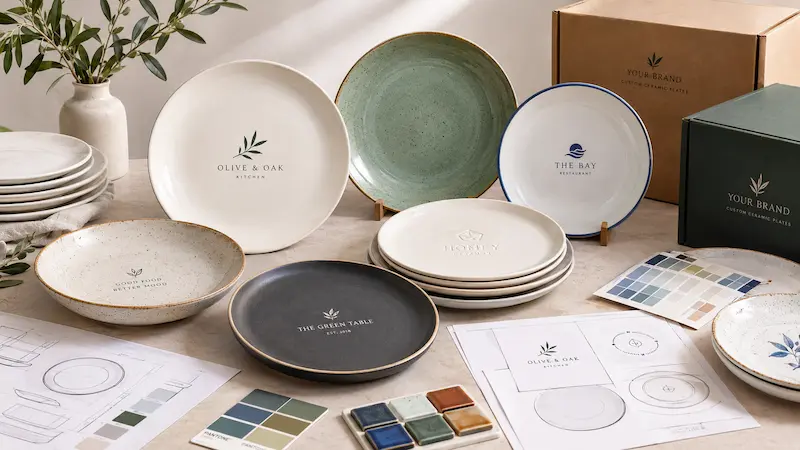
This is why custom ceramic plates are becoming an increasingly practical option for B2B buyers looking for differentiated tableware. Instead of competing with standard products available from multiple suppliers, businesses can develop plates around their own colours, logo, packaging and product positioning.
For importers, hospitality groups, restaurant chains and retailers, ceramic plate wholesale programmes can also provide better control over product specifications, pricing and long-term supply.
In this guide, we explain how private label ceramic plates are developed, which logo printing methods are available, what buyers should consider when choosing materials and suppliers, and how to plan a successful wholesale project.
1. Why Custom Ceramic Plates Are a Strategic B2B Investment
The demand for branded tableware continues across hospitality, food service, retail and gifting. Restaurants want tableware that reflects their visual identity, while hotels often require coordinated plates, bowls and cups across multiple locations. Retailers and e-commerce brands are also using private label tableware to create products that cannot be directly compared with generic alternatives.
Custom ceramic plates offer several advantages for B2B buyers:
- Stronger brand recognition
- Greater product differentiation
- More control over retail positioning
- Opportunities for premium pricing
- Consistent branding across tableware collections
- Better long-term product exclusivity
For example, a restaurant may use its logo on a porcelain dinner plate, while a lifestyle retailer may develop a complete collection with a specific glaze, shape and packaging style.
For businesses purchasing ceramic dinner plates wholesale, the right supplier should be able to support more than simple logo printing. Shape, material, colour, glaze, decoration, packaging and quality control all need to work together.
Homey Ceramic supports B2B buyers with OEM and ODM ceramic products, including tableware, decorative ceramics and customised ceramic projects.
2. What Is Private Label Ceramic Plates Wholesale?
Private label ceramic plates are products manufactured for a specific brand and sold under that brand’s name. The level of customisation can range from simply adding a logo to an existing plate to developing a completely new shape and mould.
There are three common approaches.
Stock Plate + Logo
The supplier uses an existing plate shape and adds your logo, artwork or other decoration. This is usually the simplest way to launch a private label collection.
It can reduce development time and tooling costs, making it suitable for businesses testing a new product category.
ODM Customisation
An existing ceramic plate design is modified according to your requirements. Changes may include colour, glaze, size, logo placement or packaging.
This approach provides more differentiation while avoiding some of the development costs associated with a completely new product.
Fully Custom OEM Development
For a completely unique product, the supplier develops a new mould based on technical drawings or reference designs.
This option is suitable for brands that need a distinctive plate shape, special rim profile, embossed branding or a proprietary collection.
The right choice depends on your budget, expected volume, launch schedule and desired level of exclusivity.
3. Step-by-Step: How to Launch Your Private Label Ceramic Plate Line
A successful ceramic plate wholesale project normally follows a structured development process.
Step 1: Design Confirmation & Technical Drawing
Start by providing the supplier with as much information as possible.
Useful files include:
- Reference photos
- AI, EPS or other vector logo files
- Pantone or RAL colour references
- Plate dimensions
- Desired material
- Logo size and placement
- Glaze requirements
- Packaging specifications
For a new shape, a technical drawing or 3D file can significantly improve communication between the buyer, mould maker and ceramic supplier.
Step 2: Mould Creation & Sample Development
If an existing mould is suitable, development can be considerably faster. For a completely new shape, a mould needs to be developed before samples can be produced.
For many ceramic projects, a pre-production sample can take around 7–15 days, depending on the shape, decoration and development requirements.
At this stage, buyers should carefully check:
- Dimensions
- Weight
- Shape
- Logo position
- Glaze colour
- Surface finish
- Overall appearance
The approved sample should become the reference standard for bulk production.
Step 3: First Firing
Ceramic bodies are formed and then fired at high temperatures. Depending on the material and production process, firing temperatures can reach approximately 1,200°C–1,300°C.
High-temperature firing contributes to the strength and vitrification of the ceramic body.
Porcelain, stoneware and bone china each have different characteristics, so the material should be selected according to the intended application.
Step 4: Glazing & Logo Decoration
The plate can then receive its glaze and branding.
The decoration method should be selected based on the logo design, required durability, quantity and budget.
Simple one-colour logos may require a different process from multi-colour artwork or detailed brand graphics.
Step 5: Final Firing
After decoration and glazing, the plates undergo the appropriate firing process.
For high-temperature ceramic decoration, the design becomes integrated with the ceramic/glaze surface. This can provide better resistance to normal washing and daily use than some surface-applied decoration methods.
Step 6: Quality Inspection
Before shipment, finished plates should be inspected for:
- Shape consistency
- Size and weight
- Glaze defects
- Colour variation
- Cracks or pinholes
- Logo position
- Decoration quality
- Packaging condition
For larger bulk ceramic plates orders, buyers should agree on acceptable defect levels and inspection procedures before production begins.
Step 7: Export Packaging
Ceramic products require protective packaging because they are fragile during transportation.
Depending on the sales channel, packaging can include:
- Individual brown boxes
- Printed retail boxes
- Protective inserts
- Master cartons
- Pallet loading
- Custom sleeves
- Care instruction cards
For e-commerce brands, packaging design and drop protection are particularly important.
4. Logo Printing Methods Compared
Choosing the right logo printing method is one of the most important decisions in a private label ceramic project.
| Method | How It Works | Best For | Durability | MOQ Impact |
|---|---|---|---|---|
| Underglaze Decal | Logo is applied under transparent glaze and fired at high temperature | Premium daily-use dinnerware | ★★★★★ | Medium–High |
| Overglaze Decal | Logo is applied to the glazed surface and fired at a lower temperature | Cost-sensitive or decorative products | ★★★★☆ | Low–Medium |
| Screen Printing | Ceramic ink is transferred through a mesh stencil | Simple logos and larger volumes | ★★★☆☆ | High but cost-efficient at scale |
| Laser Engraving | Logo is physically etched into the surface | Minimalist or luxury branding | ★★★★★ | Low |
| Embossed Logo | Logo is raised or debossed directly into the ceramic | Premium hospitality products | ★★★★★ | High because a new mould may be required |
| Hand Painting | Logo or artwork is applied manually by brush | Artisan and limited-edition collections | ★★★☆☆ | Very Low |
For plates intended for frequent food service use, buyers should discuss the decoration method with the supplier before finalising the artwork.
For EU and UK markets, food-contact compliance should be considered together with the glaze and decoration system. A supplier should be able to explain which tests and documentation apply to the specific material and decoration combination.
5. Material & Safety Compliance: What B2B Buyers Must Verify
The ceramic body has a direct impact on the appearance, durability and positioning of your tableware collection.
Porcelain
Porcelain is widely used for premium tableware because of its smooth surface, strength and refined appearance. It is also suitable for many forms of logo and glaze decoration.
Stoneware
Stoneware has a heavier and more casual appearance. It can work particularly well for restaurants, cafés, lifestyle retailers and rustic or handmade-style collections.
Bone China
Bone china is known for its lightweight feel and refined appearance. It can be considered for premium hospitality and retail collections where presentation is particularly important.
When sourcing ceramic plates bulk suppliers, buyers should request relevant food-contact documentation rather than relying only on general claims such as “lead-free”.
Depending on the destination market, buyers may need documentation or testing related to:
- FDA requirements for the US market
- LFGB requirements for Germany and relevant EU applications
- EU food-contact regulations
- California Proposition 65 where applicable
- Lead and cadmium migration
- Microwave safety
- Dishwasher safety
Testing requirements should always be confirmed according to the actual product, glaze, decoration and destination market.
A professional supplier should be able to explain which reports are available and whether additional third-party testing is required.
6. MOQ, Pricing & Lead Time for Ceramic Plate Wholesale
MOQ depends heavily on the level of customisation.
As a general planning reference:
- Stock plate + logo: around 500–1,000 pcs
- Custom glaze or colour: around 1,000–3,000 pcs
- New mould development: often 3,000+ pcs
These are not fixed industry rules. MOQ can vary according to the supplier, plate size, mould cost, decoration process and production schedule.
For buyers starting a new collection, it is worth asking whether a supplier can support a smaller initial trial order.
Homey Ceramic works with different ceramic manufacturers and can assess project feasibility according to the required quantity, shape and decoration. Depending on the project, an initial production run may sometimes be more flexible than a standard large-volume programme.
The main factors affecting the price of custom ceramic plates include:
- Ceramic material
- Plate dimensions
- Product weight
- Mould requirements
- Glaze type
- Logo printing method
- Number of colours
- Packaging
- Order quantity
- Testing and certification requirements
A typical project may require around 2-3weeks for sample development and approximately 35–60 days for mass production after sample approval, depending on the product and production schedule.
For an accurate quotation, provide the supplier with your reference design, dimensions, target quantity and branding requirements.
7. Packaging & Branding Extensions Beyond the Plate
Private label branding does not have to stop with the ceramic product.
A complete retail programme can include:
- Custom printed boxes
- Sleeve packaging
- Window boxes
- Protective inserts
- Hang tags
- QR codes
- Care cards
- Brand story cards
- Barcode labels
For retailers, another useful strategy is to create coordinated tableware sets.
For example:
Dinner plate + side plate + bowl + mug
Using the same glaze, logo treatment and packaging across the collection can create a stronger visual identity.
If you are looking for a broader custom ceramics service, Homey Ceramic can support different ceramic categories and coordinate customised specifications for B2B projects.
8. Common Pitfalls to Avoid
Even a simple-looking ceramic plate project can encounter problems if specifications are not confirmed early.
Skipping the Pre-Production Sample
Do not move directly from artwork to mass production without approving a physical sample when the project involves meaningful customisation.
The sample allows you to verify the actual colour, glaze, dimensions and logo appearance.
Not Defining Logo Tolerance
Logo placement should be discussed before production.
For example, if the logo must be centred on every plate, the acceptable positioning tolerance should be agreed in advance.
Ignoring Packaging Requirements
A ceramic plate can pass factory inspection but still arrive damaged if the export packaging is insufficient.
For e-commerce shipments, consider drop protection and individual product packaging from the beginning.
Choosing a Decoration Method Only by Price
The cheapest printing method is not necessarily the most suitable.
A restaurant plate used every day may require a different decoration solution from a decorative plate sold as occasional home décor.
Not Checking Food-Safety Documentation
Do not rely solely on general statements such as “food safe”. Ask what documentation applies to the specific ceramic body, glaze and decoration combination.
9. How to Vet Your Ceramic Plates Wholesale Supplier
Choosing the right ceramic plate supplier is just as important as choosing the right design.
Before placing a bulk order, ask potential suppliers about:
- Production experience
- OEM and ODM capabilities
- Factory or manufacturing partner information
- Quality control procedures
- Food-contact testing
- Previous private label projects
- Sample development
- Mould ownership
- Packaging options
- Production lead times
- Defect replacement policy
- Export experience
You can also ask specific technical questions such as:
Can you provide LFGB or other relevant test reports for this glaze and decal combination?
Can you provide photos or samples of previous private label ceramic plates?
What is the acceptable defect level for bulk production?
Can you provide inspection photos before shipment?
Can you support custom packaging?
For international buyers, communication is also an important part of supplier evaluation. A supplier should be able to understand technical requirements clearly and provide practical feedback when a requested design may be difficult to manufacture.
10. Why Work With Homey Ceramic for Custom Ceramic Plates?
For B2B buyers, sourcing ceramic dinner plates wholesale is not simply about finding the lowest unit price. The supplier needs to understand the complete process from product concept to finished shipment.
Homey Ceramic focuses on OEM and ODM ceramic products for importers, retailers, hospitality businesses and brands.
Our support can include:
- Custom ceramic plate development
- Existing mould selection
- New mould development
- Custom colours and glazes
- Logo printing and ceramic decoration
- Embossed and debossed details
- Sample development
- Production coordination
- Quality inspection
- Custom packaging
- Export shipment coordination
Because Homey Ceramic works with multiple vetted ceramic manufacturers, we can assess different production options according to the product specification rather than limiting every project to one production line.
For buyers looking for an established ceramic plate supplier, you can also explore our ceramic plates collection for reference designs.
If you already have a reference image, technical drawing or logo, you can send it to us for a feasibility assessment and quotation.
Conclusion: Turn Ceramic Plates Into a Branded Revenue Stream
For importers, retailers, restaurants, hotels and e-commerce brands, custom ceramic plates can provide much more than a functional tableware solution.
With the right combination of ceramic material, shape, glaze, logo printing and packaging, a standard plate can become part of a recognisable private label product range.
The key is to define the specifications before production, approve a physical sample, choose the right decoration method and work with a supplier that understands international B2B requirements.
Whether you need a stock plate with your logo, a custom glaze, an embossed design or a completely new mould, Homey Ceramic can help you evaluate the production feasibility and develop the right solution for your market.
Ready to develop your own private label ceramic plates?
Send us your reference image, logo, dimensions and estimated order quantity. Our team can review the requirements, recommend a suitable production approach and provide a customised quotation.
Explore our custom ceramics service or contact Homey Ceramic to discuss your next ceramic plate wholesale project.