1. Introduction
The demand for ceramic cottage wholesale products continues to grow as retailers, gift shops, garden centres, interior boutiques and online home décor stores look for distinctive products that combine decorative appeal with long-term value. Ceramic houses, miniature villages, figurines and architectural ornaments can be sold as everyday home accessories or seasonal collections, making them particularly attractive for B2B buyers.
For retailers, however, finding the right ceramic cottage wholesale supplier is not simply about finding the lowest unit price. Product quality, design consistency, production capacity, packaging, compliance, communication and delivery reliability all have a direct impact on profitability.
A supplier that delivers inconsistent glazing, fragile products or poorly packed ceramic houses can create costly returns and customer complaints. In contrast, a reliable manufacturing partner can help buyers develop collections, control quality and build a stronger product range over time.
This guide explains how to source and evaluate reliable ceramic cottage wholesale suppliers, from defining your requirements to checking samples, negotiating prices and managing international logistics. It also explains why working directly with an experienced ceramic manufacturer such as Homey Ceramic can be an effective solution for buyers looking for wholesale and customised ceramic house décor.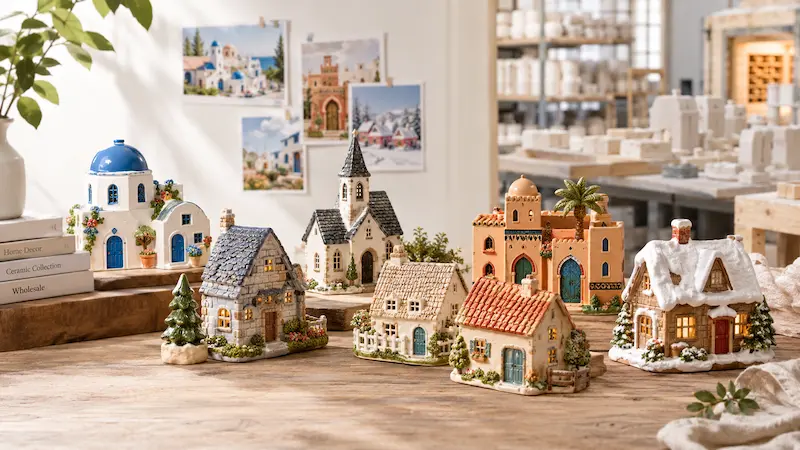
2. Understanding the Ceramic House Décor Wholesale Market
Before contacting suppliers, buyers should understand what customers are actually purchasing. The ceramic cottage wholesale market covers a broad range of decorative products, including miniature houses, village buildings, figurines, ceramic sculptures, vases, candle holders, ornaments and decorative accessories.
Ceramic village houses are particularly versatile. They can be displayed individually or arranged into complete themed collections. Retailers can also create seasonal ranges around Christmas, Halloween, Easter and other occasions.
Popular Ceramic House Décor Styles
Design trends are constantly changing, but several styles have strong commercial potential:
- Modern ceramic houses: Simple shapes, neutral colours and clean architectural details.
- Rustic ceramic houses: Textured surfaces, earthy colours and handmade-looking finishes.
- Minimalist ceramic villages: Simple silhouettes suitable for contemporary interiors.
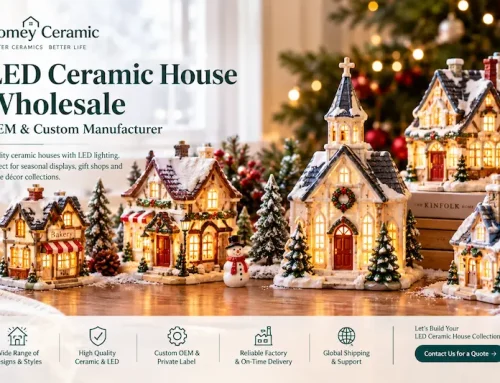
- Christmas ceramic villages: Snow-covered houses, churches, cottages and festive buildings.
- Coastal and Mediterranean designs: White walls, terracotta-inspired colours and blue accents.
Regional influences are also becoming increasingly important. Buyers can differentiate their collections through regional ceramic house styles rather than selling generic designs.
For example, a Moroccan ceramic village may feature arched doors, geometric patterns and warm earthy colours. A Nordic ceramic village typically uses clean lines, simple roof shapes and understated colours. A Mediterranean ceramic village can incorporate whitewashed walls, terracotta roofs and blue or green decorative details.
These regional ceramic house styles give retailers more opportunities to build collections around specific interior design themes.
When sourcing ceramic cottage wholesale, buyers should therefore consider both current trends and the long-term versatility of each design.
3. Defining Your Sourcing Requirements
A clear product specification makes it much easier to compare ceramic cottage wholesale suppliers.
Start with the basic product requirements:
Materials and Finish
Decide whether your products should be made from ceramic, stoneware or porcelain. Consider the desired surface finish, including matte, glossy, textured or reactive effects.
For decorative ceramic houses, the glaze should provide a consistent appearance across the collection. If the product is intended for candle use or other functional purposes, additional technical requirements may apply.
Size and Shape
Provide suppliers with target dimensions, reference drawings or product photographs. If you are developing a ceramic village, consider how individual pieces will look together.
For example, a collection may include:
- Small cottages
- Medium houses
- Large feature buildings
- Churches or shops
- Trees and accessories
- Seasonal decorative pieces
This creates visual variety while keeping the collection commercially cohesive.
Packaging
Packaging is particularly important for ceramic cottage wholesale because ceramic products can be vulnerable to impact during international transportation.
Ask suppliers about individual boxes, foam protection, inner cartons, master cartons and drop-test considerations. Good packaging can significantly reduce breakage rates.
MOQ and Samples
Minimum order quantity is another important consideration. Large factories may offer competitive prices but require high MOQs.
A supplier offering low MOQ & wholesale solutions can be more suitable for small and medium-sized brands testing a new collection.
Samples should also be requested before placing a large production order. A physical sample allows you to evaluate dimensions, glaze colour, weight, details and overall workmanship.
Customisation
If your brand requires original artwork, private labelling or unique shapes, look for a supplier with OEM/ODM capabilities.
Homey Ceramic provides a custom ceramics service for businesses that want to turn their original concepts into finished ceramic products. This can be particularly useful when developing exclusive ceramic cottage wholesale collections.
4. Finding Potential Ceramic House Décor Wholesale Suppliers
There are several ways to find potential suppliers.
Online B2B Platforms
Alibaba, Global Sources and Made-in-China can provide access to large numbers of manufacturers and trading companies. However, buyers should not assume that every supplier listed as a factory actually manufactures all products themselves.
Check:
- Factory location
- Product range
- Production facilities
- Years in business
- Export markets
- Certifications
- Customer reviews
- Customisation capabilities
Trade Shows
Trade fairs remain valuable for sourcing ceramic cottage wholesale because buyers can see actual products and meet suppliers directly.
Major sourcing events such as the Canton Fair and international home and gift shows can help buyers compare designs, finishes and prices.
Supplier Directories and Referrals
Industry associations, sourcing agents and recommendations from other home décor businesses can also help identify reliable suppliers.
When possible, ask existing buyers about product consistency, communication, lead times and after-sales support rather than focusing only on price.
5. Evaluating Supplier Credibility and Quality
Supplier evaluation is one of the most important stages of ceramic cottage wholesale sourcing.
Company Background
Look for a supplier with proven manufacturing experience and international export knowledge.
Homey Ceramic benefits from being based in Dehua, Fujian, China, one of China’s important ceramic production centres. Dehua has a long history of ceramic manufacturing and provides access to skilled ceramic workers, established supply chains and supporting production resources.
This manufacturing environment gives Homey Ceramic a strong foundation for producing ceramic tableware, decorative ceramics, seasonal products and custom ceramic designs.
Production Capability
Ask whether the supplier produces products in-house or relies heavily on subcontractors.
For customised ceramic cottage wholesale, direct manufacturing capability can improve communication between product development, mould making, glazing, decoration and quality control.
Certifications and Compliance
Depending on the product and destination market, buyers may need to consider applicable food-contact, chemical and product-safety requirements.
For functional ceramic products, buyers may request documentation relating to standards such as FDA requirements, EU food-contact regulations, LFGB testing or other destination-market requirements.
Even when ceramic houses are purely decorative, buyers should still discuss material and glaze safety with their supplier.
Factory Audits
A factory audit can provide additional confidence regarding production capacity, quality systems and working conditions.
For overseas buyers who cannot travel to China, a virtual factory tour can still provide useful information.
Product Samples
Never evaluate ceramic cottage wholesale solely from catalogue photographs.
A sample allows you to check:
- Ceramic body quality
- Glaze consistency
- Colour accuracy
- Surface defects
- Dimensional accuracy
- Detail and craftsmanship
- Packaging quality
Homey Ceramic supports customers through the sample development process before moving into bulk production, helping buyers confirm the product before committing to larger orders.
6. Negotiating Terms and Building Relationships
Price is important, but the cheapest ceramic house décor wholesale supplier is not necessarily the most profitable supplier.
When comparing quotations, consider the complete cost:
Unit price + mould/tooling + packaging + inspection + freight + import costs + potential breakage.
Ask suppliers whether bulk discounts are available at different order quantities. A supplier may offer different pricing for 100, 500, 1,000 or 5,000 pieces.
Payment terms should also be clearly documented. Buyers should confirm the deposit, balance payment, production schedule and conditions for approving samples.
Lead Times
Ceramic production involves multiple stages, including mould preparation, casting or forming, drying, firing, glazing, decoration and final inspection.
For customised products, allow additional time for 3D development, mould production and sample approval.
Communication
Good communication is essential for successful ceramic cottage wholesale projects.
Provide drawings, dimensions, colour references and packaging requirements in writing. When discussing colours, use Pantone references or physical samples where possible.
Homey Ceramic works with international customers on OEM and ODM projects and can support communication throughout product development, sampling and production.
The goal should be to build a long-term manufacturing relationship rather than repeatedly changing suppliers based on small price differences.
7. Managing Logistics and Import Compliance
Ceramic products require careful logistics planning because they are relatively fragile and can be damaged by impact or pressure.
Shipping Options
For larger ceramic cottage wholesale orders, sea freight is usually the most economical option. Air freight and courier services can be considered for samples or urgent smaller shipments.
Common Incoterms include:
- EXW: Buyer handles transportation from the factory.
- FOB: Supplier delivers goods to the agreed port and handles export procedures.
- CIF: Supplier arranges transportation and insurance to the destination port.
Buyers should compare quotations based on the same Incoterm so that pricing is genuinely comparable.
Packaging and Quality Control
Before shipment, buyers should confirm carton quantities, inner protection and master carton specifications.
Pre-shipment inspections can verify product quantity, dimensions, colours, workmanship and packaging.
For fragile ceramic cottage wholesale, quality control should not stop at the product itself. Packaging should be treated as part of the overall product specification.
8. Common Pitfalls to Avoid When Sourcing Ceramic Décor
Several mistakes can turn an attractive ceramic cottage wholesale quotation into an expensive sourcing problem.
Choosing Only by Price
An unusually low price may indicate lower-grade ceramic bodies, simplified finishing, inadequate quality control or insufficient packaging.
Not Checking Samples
A digital rendering may look perfect while the actual ceramic product has differences in proportions, glaze colour or surface quality.
Always approve a physical sample whenever possible.
Ignoring Breakage Risks
Ceramic houses have protruding details such as chimneys, roofs, windows and doors. These areas can be vulnerable during transportation.
Discuss packaging requirements before production begins.
Poor Documentation
All specifications should be documented, including dimensions, materials, colours, decoration, packaging and acceptable tolerances.
Unclear Customisation Terms
For OEM/ODM ceramic cottage wholesale, clarify who owns the mould, artwork and tooling, as well as whether the design can be sold to other customers.
9. Case Study: Developing a Custom Ceramic Village Collection
Consider a home décor retailer preparing to launch an exclusive ceramic village collection.
Instead of selecting generic products from a catalogue, the buyer works with a manufacturer to create three coordinated styles: a Moroccan ceramic village, a Nordic ceramic village and a Mediterranean ceramic village.
The Moroccan collection uses warm colours, arches and geometric details. The Nordic collection focuses on minimalist architecture and neutral tones. The Mediterranean collection combines white ceramic walls with blue and terracotta-inspired accents.
The manufacturer develops the shapes, creates samples and adjusts the glazing based on the buyer’s feedback. Once the samples are approved, production specifications are documented to maintain consistency between batches.
This approach gives the retailer a stronger product identity than simply purchasing generic ceramic cottage wholesale products.
The key lesson is that the right manufacturing partner can contribute much more than production. A capable supplier can become part of the product-development process.
10. Why Choose Homey Ceramic for Ceramic House Décor Wholesale?
For B2B buyers searching for reliable ceramic cottage wholesale, Homey Ceramic offers several advantages.
Dehua Manufacturing Advantage
Homey Ceramic is based in Dehua, Fujian, China, a well-established ceramic manufacturing region. This provides access to ceramic production expertise, skilled workers and a mature supporting supply chain.
OEM and ODM Capability
Homey Ceramic can work with buyers who have their own designs as well as businesses looking for assistance developing new products.
From concept and 3D development to mould production, sampling and bulk manufacturing, the process can be adapted to the project’s requirements.
Custom Design Support
Retailers can develop exclusive ceramic houses, village collections, seasonal decorations and other architectural ceramic ornaments rather than relying entirely on standard catalogue products.
This is especially valuable for brands that want distinctive regional ceramic house styles, including Moroccan, Nordic and Mediterranean-inspired collections.
Low MOQ and Wholesale Solutions
Not every retailer is ready to order thousands of pieces immediately. Homey Ceramic can provide flexible wholesale solutions and discuss lower MOQ options for suitable projects.
This allows businesses to test new ceramic cottage wholesale collections before scaling successful designs.
Quality Control
Quality control is integrated into the production process, covering ceramic bodies, glazing, decoration, dimensions, packaging and finished products.
For wholesale buyers, consistent quality is essential because products from different production batches may ultimately be sold together.
International Export Experience
Homey Ceramic has experience working with international B2B customers and understands the practical requirements involved in overseas orders, including packaging, documentation, production schedules and shipping.
For buyers looking for a broader range of home décor products, explore the ceramic decoration supplier collection for additional sourcing possibilities.
11. Conclusion
Finding the right ceramic cottage wholesale supplier requires more than comparing unit prices. Successful sourcing involves evaluating manufacturing capability, product quality, compliance, MOQ, customisation, packaging, logistics and communication.
Start by defining your product requirements clearly. Then compare potential suppliers based on their production experience, samples, quality-control systems and export capabilities.
Regional design concepts can also help your collection stand out. A Moroccan ceramic village, Nordic ceramic village or Mediterranean ceramic village can give retailers a clear design story and help create cohesive collections.
For businesses looking for a manufacturing partner rather than simply a catalogue supplier, Homey Ceramic offers a combination of Dehua manufacturing expertise, OEM/ODM production, custom design support, flexible wholesale solutions and international export experience.
Whether you are developing a small test collection or planning a larger retail programme, choosing the right supplier at the beginning can significantly reduce quality and logistics risks while improving long-term margins.
If you are planning a new ceramic cottage wholesale collection, contact Homey Ceramic to discuss your designs, target quantities, packaging requirements and sampling needs. Share your ideas with Homey Ceramic and request a quotation for your custom ceramic house décor project.