I. Introduction
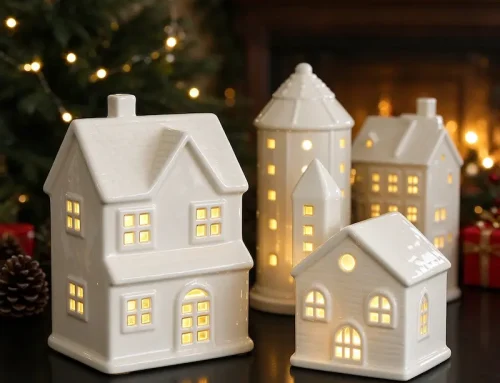
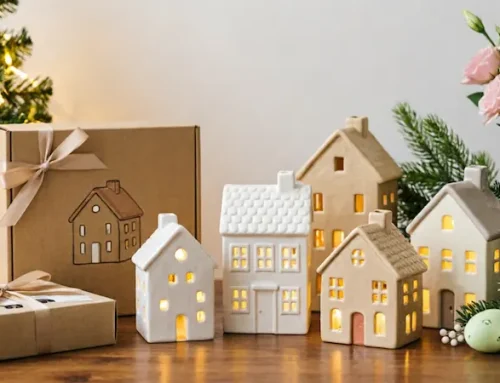
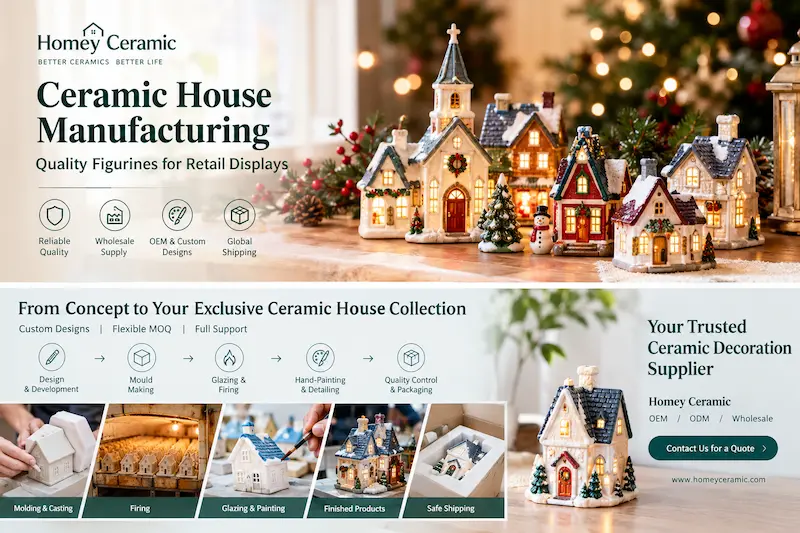
Ceramic houses have a timeless appeal in both seasonal and year-round home décor. From charming Christmas village displays to miniature cottages, Nordic-style homes, and illuminated decorative houses, these small ceramic pieces can create a warm and inviting atmosphere in retail stores and homes.
For retailers, however, sourcing attractive designs is only one part of the challenge. Consistent quality, competitive pricing, reliable production schedules, safe materials, and secure packaging are equally important. A beautiful ceramic house that arrives with cracked roofs, uneven glaze, or damaged details can quickly turn into a costly inventory problem.
This is why choosing the right partner for ceramic house manufacturing is essential for wholesale buyers. A reliable manufacturer can help retailers develop attractive products while maintaining consistent quality and manageable production costs.
As part of the wider ceramic home decor manufacturing industry, ceramic house production combines traditional ceramic craftsmanship with modern mould development, glazing, decoration, quality control, and international logistics.
For retailers planning to build a profitable collection of ceramic house décor, working directly with an experienced manufacturer such as Homey Ceramic can make the sourcing process much easier. With OEM and ODM capabilities, buyers can develop both ready-to-order designs and completely customised ceramic house collections.
II. The Business Case: Why Invest in Ceramic House Figurines?
Consistent Demand for Decorative Ceramic Houses
Ceramic house figurines appeal to a wide range of consumers because they work across different décor themes and seasons.
During the Christmas season, ceramic houses are commonly used to create miniature Christmas villages. Retailers may combine cottages, churches, shops, houses, trees, and other village elements to create complete collections.
Outside the holiday season, house-shaped ceramics can also be marketed as:
- Everyday home décor
- Shelf and mantel decorations
- Cottage-style interior accessories
- Miniature collectible houses
- Tea light or LED houses
- Seasonal decorations
- Gift items
- Tabletop centrepieces
This versatility gives wholesale buyers more opportunities to sell the same product category throughout the year.
Attractive Opportunities for Wholesale Buyers
One of the main advantages of wholesale ceramic house manufacturing is the ability to purchase directly from the production source. Instead of relying on multiple layers of distributors, retailers can work with a manufacturer to discuss designs, materials, quantities, packaging, and target pricing.
This can improve cost control and make it easier to develop products for specific markets.
The growth of ceramic house figurine manufacturing has also encouraged factories to develop more styles, including rustic cottages, European village buildings, modern houses, Moroccan-inspired structures, Scandinavian homes, Christmas houses, and illuminated ceramic houses.
For buyers, the key is not simply finding the cheapest supplier. The goal is to find a manufacturer that can deliver the right balance of design, craftsmanship, consistency, price, and service.
III. Understanding the Process: Wholesale Ceramic House Manufacturing
Understanding how ceramic houses are produced helps wholesale buyers communicate more effectively with suppliers and establish realistic production schedules.
The Journey from Clay to Figurine
1. Moulding and Casting
Most ceramic house figurines begin with a master model or 3D design. The manufacturer uses this model to create a production mould.
For detailed houses, mould design is particularly important. Features such as windows, doors, roof tiles, chimneys, bricks, balconies, and decorative patterns need to be reproduced accurately.
Depending on the product structure and production method, manufacturers may use casting, pressing, slip casting, or other ceramic forming techniques.
A professional ceramic house figurine factory should be able to advise buyers on the most suitable production method according to the design, dimensions, quantity, and target price.
2. Bisque Firing
After forming, the ceramic pieces are dried carefully before being fired.
The first firing, commonly called bisque firing, removes remaining moisture and strengthens the ceramic body. Temperature control is critical because poor drying or improper firing can result in warping, cracking, or dimensional inconsistencies.
For wholesale buyers, stable firing conditions are particularly important when ordering thousands of pieces. Even small variations between production batches can become visible when products are displayed side by side.
3. Glazing and Final Firing
After bisque firing, glaze may be applied to create the desired colour, texture, and surface finish.
Ceramic house décor can use a wide variety of finishes, including:
- Glossy glaze
- Matte glaze
- Semi-matte glaze
- Reactive finishes
- Speckled ceramic
- Two-tone finishes
- Metallic accents
The glaze must be applied consistently. Problems such as pinholes, crawling, uneven coverage, colour variation, and excessive glaze thickness should be identified during quality control.
4. Hand-Painting and Detailing
Many ceramic houses combine factory production with hand-finishing.
Small details such as doors, windows, roof edges, signs, flowers, snow effects, or architectural accents may require hand painting or manual decoration.
This is one reason ceramic houses can have a handcrafted appearance even when they are manufactured in large quantities.
A capable manufacturer should have clear decoration standards so that hand-painted products remain consistent from piece to piece.
Understanding these steps allows buyers to discuss development and production more accurately. It also helps retailers understand why complex ceramic house figurine manufacturing may require more development time than simple ceramic shapes.
IV. How to Find and Vet a Reliable Ceramic House Figurine Factory
Choosing the right factory is one of the most important decisions in wholesale sourcing.
A professional ceramic house figurine factory should provide more than attractive product photos. Buyers should evaluate the complete production process.
Key Criteria for Supplier Selection
Production Capacity and MOQ
First, check whether the factory can handle your expected order quantity.
A small retailer may require a relatively low MOQ for market testing, while a large distributor may need thousands of pieces per design.
Ask the manufacturer:
- What is the MOQ per design?
- Can different designs be combined in one order?
- What is the monthly production capacity?
- How long does mass production take?
- Can the supplier support repeat orders?
- Can packaging be customised?
For new collections, flexible MOQ options can help retailers test the market before committing to very large quantities.
Materials and Compliance
Quality ceramic house production starts with appropriate raw materials.
Wholesale buyers should ask about ceramic body materials, glaze specifications, decoration materials, and applicable safety requirements.
For decorative products, lead-free and cadmium-free glaze options may be important depending on the destination market and product application.
If the product includes a candle or LED function, additional considerations may include heat resistance, electrical components, ventilation, and packaging protection.
Communication and Lead Times
Communication is another major factor.
A supplier may have excellent products but still become difficult to work with if communication is slow or specifications are misunderstood.
Before placing an order, evaluate how quickly the manufacturer responds to:
- Design questions
- Sample revisions
- Colour adjustments
- Packaging requirements
- Production updates
- Quality issues
- Shipping arrangements
Clear communication can prevent expensive mistakes during wholesale ceramic house manufacturing.
Factory Audit Checklist
Whether you visit the factory in person or conduct a virtual audit, look at:
- Raw material storage
- Mould-making facilities
- Ceramic forming areas
- Kilns and firing equipment
- Glazing areas
- Painting and decoration teams
- Quality inspection procedures
- Finished-product storage
- Packaging facilities
- Export and logistics experience
A manufacturer with experience across ceramic home decor manufacturing can often support buyers with a wider range of related products, making it easier to build a complete seasonal collection.
V. Standing Out in Retail: OEM Ceramic House Manufacturing
Building Your Own Brand of Collectibles
For retailers looking for more than standard catalogue products, OEM ceramic house manufacturing offers an opportunity to develop exclusive collections.
OEM, or Original Equipment Manufacturing, allows buyers to provide their own design concepts, artwork, dimensions, colours, branding, and packaging requirements.
Instead of selling the same house figurines available from multiple suppliers, retailers can create products designed specifically for their own brand.
From 2D Sketch to 3D Ceramic House
The customisation process can begin with something as simple as a hand-drawn sketch, reference photo, CAD file, or mood board.
A professional manufacturer can then help convert the concept into a production-ready design.
The process may include:
- Reviewing the original concept
- Confirming dimensions and proportions
- Creating a 3D drawing or model
- Developing a prototype
- Creating the production mould
- Selecting ceramic materials
- Developing glaze colours
- Adding decals or hand-painted details
- Developing custom packaging
- Producing a final approval sample
For buyers interested in custom collections, Homey Ceramic’s custom ceramics service can support the development process from concept to finished ceramic product.
Creating Exclusive Products
Exclusivity is one of the biggest advantages of OEM production.
A unique ceramic cottage, Christmas village building, or branded miniature house gives retailers greater control over their product positioning. It can also reduce direct price competition because competitors cannot simply offer the identical catalogue item.
Custom ceramic houses can be designed around a retailer’s existing brand style, including specific colours, architectural details, logos, packaging, and seasonal themes.
For businesses building a long-term décor collection, OEM ceramic house manufacturing can therefore become an important part of brand development rather than simply a sourcing method.
VI. Quality Control and Shipping Fragile Goods
Protecting Your Investment
Ceramic is durable after firing, but ceramic figurines are still vulnerable to impact during handling and international transportation.
This makes quality control and packaging essential parts of successful ceramic house manufacturing.
Approve a Pre-Production Sample
Before mass production begins, wholesale buyers should approve a final sample, sometimes called a golden sample.
The approved sample should clearly establish:
- Dimensions
- Ceramic material
- Glaze colour
- Surface finish
- Decoration
- Logo placement
- Lighting components, if applicable
- Packaging requirements
The factory can then use this sample as a reference throughout mass production.
In-Line and Final Inspection
Quality inspections should be carried out during production and before shipment.
Common ceramic defects include:
- Cracks
- Warping
- Pinholes
- Glaze crawling
- Uneven glaze
- Colour variation
- Missing decoration
- Broken architectural details
- Poorly fitted components
For larger orders, buyers should discuss inspection standards and acceptable defect levels with the manufacturer before production.
Protective Packaging
Packaging is particularly important for ceramic house figurines because houses often have delicate roofs, chimneys, windows, and protruding details.
A suitable packaging solution may include custom EPS foam, EPE protection, moulded inserts, inner boxes, and strong export cartons.
Packaging should be designed around the actual product rather than using a generic carton that leaves excessive movement inside.
An experienced ceramic home decor manufacturing partner can help buyers balance product protection with packaging cost and container efficiency.
VII. Why Choose Homey Ceramic for Ceramic House Manufacturing?
For wholesale buyers looking for a long-term manufacturing partner, Homey Ceramic combines ceramic production experience with OEM and ODM development capabilities.
The company can support buyers with ceramic décor, seasonal decorations, tableware, vases, candle holders, and other ceramic products. This broader production experience is useful for retailers who want to develop coordinated collections instead of purchasing individual products from different suppliers.
Homey Ceramic’s key advantages include:
- OEM and ODM ceramic product development
- Custom mould and design support
- Multiple ceramic material options
- Custom glaze and decoration
- Professional sample development
- Quality control during production
- Custom packaging solutions
- Wholesale and bulk-order support
- Experience with international buyers
- Support for seasonal and home décor collections
Buyers can also explore the ceramic decoration supplier collection for inspiration when planning a new product range.
Whether you need traditional Christmas village houses, modern minimalist cottages, rustic ceramic homes, illuminated houses, or completely custom designs, working directly with a manufacturer can simplify product development and improve cost control.
VIII. Conclusion
Successful ceramic house sourcing is about much more than finding an attractive product catalogue.
Wholesale buyers need to understand the manufacturing process, evaluate production capacity, confirm material and quality standards, approve pre-production samples, and make sure fragile products are properly packaged for international shipping.
A reliable ceramic house figurine factory should also be able to support product development, colour matching, mould creation, decoration, packaging, and repeat production.
For retailers looking to build a differentiated collection, OEM ceramic house manufacturing provides an even stronger opportunity. Custom designs can help create exclusive products, strengthen brand identity, and reduce direct price competition.
The right manufacturing partner can become a long-term retail asset. Instead of treating your supplier as simply a source of products, look for a partner that understands design, production, quality control, packaging, and international wholesale requirements.
If you are planning a new ceramic house collection or looking for a reliable ceramic house manufacturing partner, contact Homey Ceramic for product ideas, catalogue options, custom development, and a wholesale quotation. Whether you need a small test order or a large OEM collection, Homey Ceramic can help turn your ceramic house concept into a production-ready product for your retail market.